Invisible Grills vs Traditional Grills: Which Is Better for Your Home?
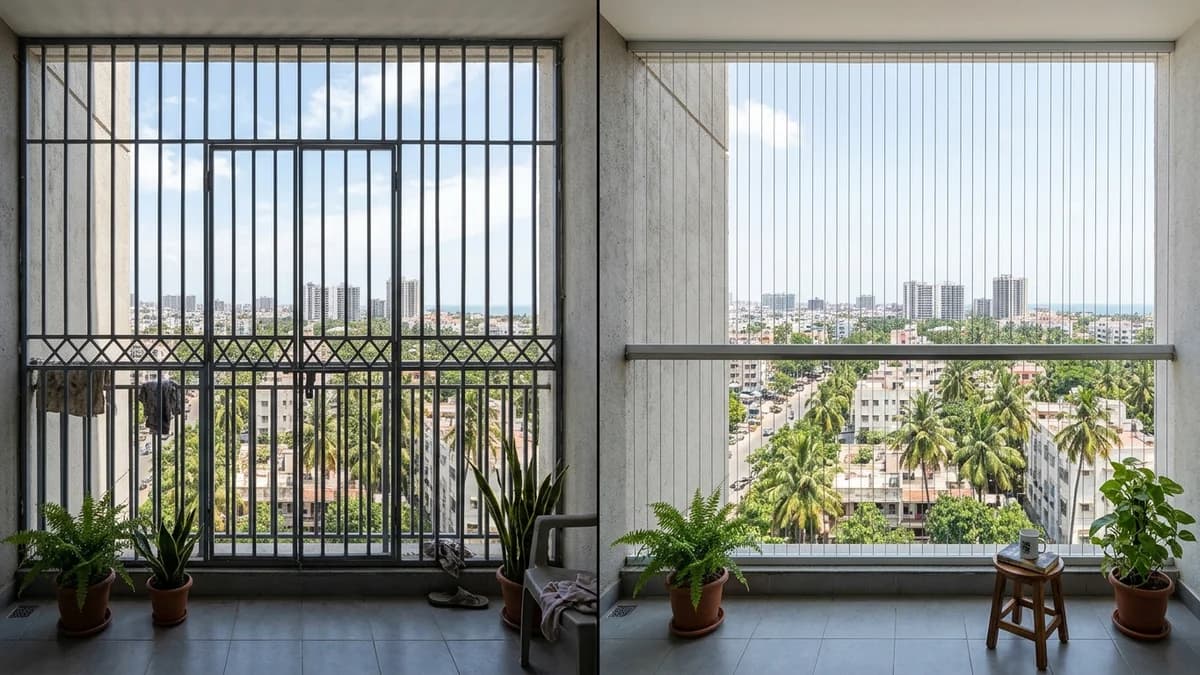
When planning balcony and window protection for homes and apartments in Chennai, homeowners routinely compare invisible stainless-steel grills with traditional mild-steel or iron grills. Invisible grills prioritise visual openness and unobstructed airflow, whereas traditional metal grills provide a more visibly solid and rigid physical barrier. The ideal choice depends on individual budget, site conditions, intended safety use, architectural rules, maintenance expectations, and installation quality.
Core Decision Factor for Property Owners
Neither system is universally superior in every situation. An invisible grill excels at preserving natural light, skyline views, and building facade elegance on upper-floor balconies. Conversely, a traditional iron grill provides a heavy, visible deterrent favoured on accessible ground-floor windows.
In this guide, the technical team at Poorna Pigeon Nets & Invisible Grills breaks down the six fundamental comparisons between invisible and traditional grills to help you make an objective, well-informed choice for your Chennai property.
Comparison 1: Appearance, View and Natural Light
The most immediate difference between the two systems is their visual impact on your living space:
Invisible Grills
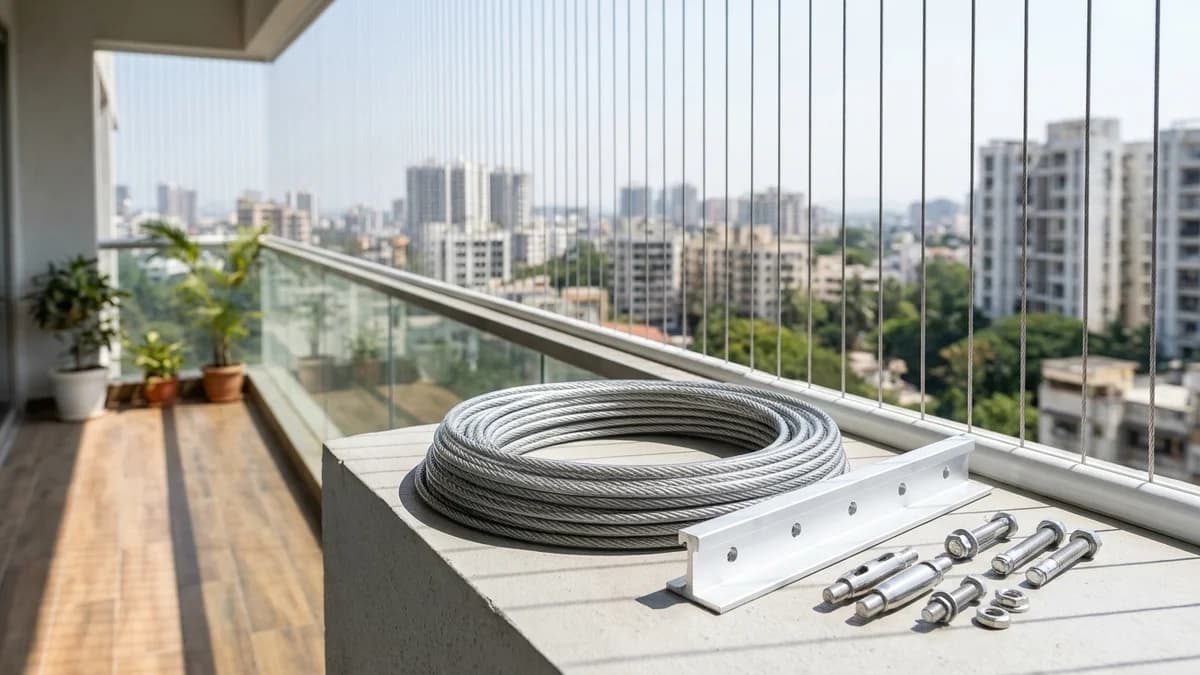
Constructed using slim, high-tensile stainless-steel wire ropes (typically 2.5 mm to 3.0 mm in diameter) spaced at regular 2-inch or 3-inch intervals. From a distance of 10 to 15 feet, the thin cables become virtually imperceptible to the human eye.
Impact on Space: Preserves uninterrupted panoramic views of the city skyline, surrounding greenery, and the sea. Balconies retain an open, airy ambience, and adjacent living rooms receive maximum natural daylight and uninhibited cross-ventilation.
Traditional Metal Grills
Fabricated from solid mild-steel (MS) or wrought-iron sections (typically 10 mm to 12 mm square or round bars), often welded into geometric box patterns, diamond lattices, or ornamental scrollwork.
Impact on Space: The thick, dark bars create a distinct visual frame across the opening. While they do not completely block daylight, they cast noticeable shadows into the room and can impart a somewhat heavy, enclosed, or cage-like feeling to compact apartment balconies.
Practical Balcony Example in Chennai
Consider a standard 10-foot by 6-foot apartment balcony overlooking a garden courtyard in Anna Nagar or the coastline along OMR.
- With an invisible grill, the floor-to-ceiling glass sliding doors feel seamlessly connected to the outside world. Sitting on a sofa inside the living room, you see right through the fine vertical cables without obstruction.
- With a traditional iron box grill, your field of view is segmented by dozens of dark vertical bars and horizontal cross-members. For homeowners who prefer a visually solid boundary, this feels reassuring; for those who paid a premium for a high-floor view, it can feel like a visual compromise.
It is worth noting that invisible grills do not block zero light (the fine wires produce microscopic diffraction), and traditional grills do not leave a room in darkness. However, for contemporary architecture emphasizing minimalism and light, invisible grills offer a distinctly modern aesthetic.
Comparison 2: Material, Rust and Chennai's Climate
Chennai's coastal environment presents unique challenges for metal building components. With relative humidity often ranging between 75% and 85%, combined with airborne salt aerosols swept inland from the Bay of Bengal and heavy northeast monsoon rains, metallurgy plays a decisive role in long-term performance:
Invisible Grill Metallurgy: Stainless Steel Alloys
Quality invisible grill cables are manufactured from austenitic stainless steel, primarily AISI Grade 304 or AISI Grade 316.
- Grade 304: Contains 18% chromium and 8% nickel. It resists normal atmospheric moisture effectively in sheltered inland areas, but can develop superficial brown "tea-staining" if exposed to continuous coastal sea mist without regular cleaning.
- Grade 316: Contains 16-18% chromium, 10-14% nickel, and 2.0% to 3.0% molybdenum. Molybdenum provides active resistance against chloride pitting corrosion, making SS 316 the preferred specification for Chennai's coastal belt (ECR, Besant Nagar, Marina, Thiruvanmiyur).
Traditional Grill Metallurgy: Mild Steel and Wrought Iron
Traditional metal grills are fabricated from carbon steel (mild steel) or ornamental wrought iron. Unlike stainless steel, mild steel contains virtually no chromium or nickel. It relies entirely on external paint or powder coating to keep oxygen and moisture away from the raw iron.
In Chennai's saline air, any tiny imperfection—such as a chip from a potted plant, hairline micro-cracks at welded corner joints, or weathered primer—exposes the bare iron beneath. Moisture and airborne salts trigger rapid oxidation (red rust). Once rust starts inside a joint or beneath paint, it tends to expand and spread, causing paint to flake and requiring mechanical scraping and repainting every two to three years.
A Balanced Perspective: Stainless steel is not indestructible; if dirt, acid fumes, or coastal salt deposits remain unwashed for extended periods, even SS 316 can show minor surface discoloration. Similarly, a high-quality mild-steel grill with hot-dip galvanising or multi-coat polyurethane industrial paint can resist corrosion for years. Always verify the material specifications and protective coatings in writing before comparing estimates.
Comparison 3: Safety, Strength and Installation Quality
Homeowners frequently ask: "Can thin cables really be as strong as solid iron bars?" The answer depends on understanding how each system achieves its structural integrity:
How Invisible Grills Deliver Strength
Invisible grills derive their strength from high-tensile wire rope mechanics. Each multi-strand stainless-steel cable is tensioned under calibrated mechanical pressure between structural extruded aluminium tracks anchored into the building's concrete slab.
- Tensile Load Capacity: High-grade stainless-steel cables are engineered with high tensile strength, meaning they can absorb substantial lateral impact without snapping.
- Intermediate Stiffeners: Because long vertical cables can have slight natural deflection at their midpoint, professional installers add horizontal cross-stiffeners (spacer clips) on openings taller than 4 to 5 feet. This locks the cables into a unified structural grid, preventing children or pets from spreading adjacent cables apart.
- Substrate Anchorage: The assembly relies entirely on heavy-duty mechanical expansion anchor bolts driven into solid reinforced concrete.
How Traditional Grills Deliver Strength
Traditional grills rely on raw mass, rigid material bulk, and welded perimeter connections.
- Rigid Physical Barrier: Solid 10 mm or 12 mm metal bars do not flex or deflect under hand pressure. They present an uncompromising, physically immovable surface.
- Visual Deterrence: For ground-floor apartments, independent villas, or perimeter compound windows, the visible bulk of an iron grill acts as a clear psychological and physical barrier against intrusion.
- Weld Quality Dependency: The safety of a traditional grill depends directly on the welder's skill. Cold welds, incomplete penetration, or poorly anchored perimeter grouting can weaken an otherwise heavy frame.
Important Safety Reminder: No grill system—whether cable-based or iron-bar—replaces active adult supervision. Neither product should be treated as an absolute guarantee against accidents. For families seeking comprehensive protection, exploring professional child safety nets for balconies and dedicated balcony safety solutions provides an engineered barrier tailored to your building's specific architectural layout.
Comparison 4: Initial Cost and Long-Term Expenses
Comparing the financial investment between invisible grills and traditional grills requires looking at both the upfront installation invoice and the cumulative ownership expenses over a 5 to 10-year horizon:
| Cost Factor | Invisible Grills | Traditional Metal Grills |
|---|---|---|
| Upfront Material Cost | Higher base raw material cost (marine stainless steel, extruded 6063 aluminium tracks, precision fasteners). | Variable; simple mild-steel rod designs can have a lower initial raw material cost, though ornamental designs increase expense. |
| Fabrication & Installation Labour | Clean, on-site mechanical anchoring and cable tensioning; usually completed in 3 to 5 hours without welding smoke. | Requires off-site cutting and welding, delivery of heavy frames, and on-site wall chipping, grouting, and touch-up painting. |
| Repainting Expenses | Zero repainting required; stainless steel and aluminium need no periodic coatings. | Periodic repainting every 2–3 years in coastal Chennai (sanding, red oxide primer, enamel paint, painter labor). |
| Long-Term Maintenance Cost | Minimal; occasional water wipe-down and hardware tension checks. | Moderate to high; recurring rust treatment and paint upkeep over 5 to 10 years. |
While a simple iron grill may have a slightly lower initial purchase price, the ongoing costs of scraping, priming, and repainting in Chennai's humid coastal climate narrow the total cost gap over time. Homeowners should request itemised quotations that clearly identify all components, delivery charges, and installation labour before comparing figures.
Comparison 5: Cleaning, Maintenance and Durability
Every outdoor fixture requires routine upkeep to look clean and function safely. Here is how maintenance routines differ:
Maintenance for Invisible Grills
- • Dust Removal: Wipe the smooth nylon-coated cables with a damp microfiber cloth every few weeks to remove dust and urban traffic grime.
- • Salt Rinsing: In coastal neighbourhoods, rinse the cables and tracks with clean tap water occasionally to wash away accumulated salt aerosol.
- • Tension Check: Every six to twelve months, gently pull adjacent cables to verify uniform tension. If any cable feels loose, contact your installer for re-tensioning.
Maintenance for Traditional Grills
- • Crevice Cleaning: Dust and bird droppings accumulate easily in welded corners, bottom channels, and ornamental scrolls, requiring stiff brushes to clean.
- • Rust Spotting: Inspect joints and bottom bars every few months for paint blisters. Rust spots must be wire-brushed immediately to prevent corrosion spreading into the bar core.
- • Full Repainting: Plan for a complete repaint every two to three years in Chennai to preserve the protective barrier against monsoon moisture.
Neither system is completely maintenance-free. However, invisible grills eliminate the need for harsh paint stripping, toxic chemical primers, and messy sanding on high-rise balconies.
Comparison 6: Privacy, Emergency Access and Practical Suitability
Beyond daily aesthetics and maintenance, safety barriers must interact responsibly with emergency protocols, privacy needs, and building association rules:
Privacy Considerations
Neither an invisible grill nor a standard metal grill provides visual privacy on its own. While traditional grills create a slightly denser silhouette, outsiders can still see through the bars into your home. If privacy from adjacent towers is a priority, homeowners should pair their safety installation with indoor blinds, exterior sunscreens, or balcony planters.
Emergency Egress and Fire Safety
In the event of a domestic fire or building emergency where internal corridors and stairwells are blocked by smoke, a balcony often serves as a vital secondary escape point for rescue ladders or fresh air.
- Traditional Welded Grills: Fully welded iron box grills permanently lock occupants inside. In an emergency, cutting through solid steel bars requires heavy hydraulic cutters or gas torches, which can delay rescue efforts unless an authorised hinged emergency wicket door was incorporated into the design.
- Invisible Grills: While high-tensile stainless steel cables cannot be pulled apart or cut with common household scissors, they can be severed in an emergency using a dedicated high-leverage wire cutter. Many installers provide an insulated emergency wire cutter mounted in a designated, accessible location near the balcony door for rapid egress.
Building Regulations: Always verify that any installation complies with National Building Code (NBC) escape provisions and your Apartment Owners Association (RWA) bylaws. Never obstruct a designated fire escape route with fixed, non-openable barriers.
Summary Comparison Table: Invisible vs. Traditional Grills
This quick reference table compares both systems across the ten most common homeowner criteria:
| Comparison Parameter | Invisible Stainless-Steel Grills | Traditional Metal-Bar Grills |
|---|---|---|
| Appearance and Visibility | Ultra-slim, minimalist; virtually transparent from a short distance. | Prominent, solid bars; distinct framing and geometric shapes. |
| Natural Light and Views | Maximises sunlight and preserves unhindered panoramic skyline views. | Allows light through, but bars cast shadows and segment exterior views. |
| Common Materials | AISI SS 316 or SS 304 wire rope with aluminium tracks and SS anchors. | Mild steel (carbon steel) or wrought iron bars with welded joints. |
| Corrosion Considerations | High resistance in coastal air when SS 316 is specified; no rust peeling. | Prone to rust if paint chips; vulnerable to salt air in coastal Chennai. |
| Initial Installation Cost | Moderate to premium upfront cost due to specialised marine-grade materials. | Variable; simple designs can be economical, decorative work increases price. |
| Ongoing Maintenance | Low; occasional microfiber wipe-down, tap-water rinsing, and tension checks. | Moderate to high; periodic scraping, priming, and repainting every 2–3 years. |
| Design Flexibility | Clean vertical or horizontal cable alignments; custom gap spacing. | Wide ornamental variety; custom scrollwork, box projections, and colours. |
| Safety Considerations | High tensile fall protection for balconies; requires appropriate cable spacing. | Rigid physical containment barrier; excellent intruder deterrence on lower floors. |
| Emergency Access | Can be severed rapidly using dedicated emergency wire cutters. | Fixed bars require heavy cutting tools unless an operable gate is built in. |
| Best-Fit Homeowner Priorities | Apartment balconies, open skyline views, modern aesthetic, low upkeep. | Ground-floor security, traditional architecture, rigid physical barrier preference. |
Which Is Better for an Apartment Balcony in Chennai?
For high-rise apartment living in Chennai—whether along the OMR IT Corridor, in Velachery, or across Central Chennai—invisible grills are generally the better fit for modern balcony spaces. They preserve cooling sea breezes, maintain architectural elegance, prevent pigeons from roosting when installed with 2-inch spacing, and satisfy the strict facade regulations of most Apartment Owners Associations.
However, for ground-floor apartments, independent houses, or perimeter windows vulnerable to street-level intrusion, a well-fabricated traditional iron grill remains a strong, cost-effective choice where a visible physical deterrent is the primary requirement. For properties where bird infestation is the main concern, installing dedicated pigeon safety nets can also be evaluated as a lightweight, economical alternative.
Which Option Is Better for Families with Children or Pets?
Both systems can provide a reliable safety perimeter when designed and installed properly:
- For Invisible Grills: Opt for a 2-inch (~50 mm) cable spacing rather than wider 3-inch or 4-inch spacing. Ensure intermediate cross-stiffeners are installed at mid-height to eliminate cable divergence. The smooth nylon coating also ensures curious toddler fingers and pet paws will not get scratched by rough metal.
- For Traditional Grills: Ensure vertical bars are spaced closely enough (typically no more than 4 inches apart) to prevent a child's head or body from slipping through, and avoid horizontal decorative elements that can act as a ladder for climbing toddlers.
Regardless of the system you select, active adult supervision remains essential whenever young children or pets are on an open balcony.
What Should You Ask Before Hiring a Grill Installer?
Before hiring an installer or approving an advance payment in Chennai, ask for written confirmation on these eight essential points:
1. Exact Metal Grade and Certification
For invisible grills, confirm whether the cable core is genuine AISI SS 316 or SS 304 and request a Mill Test Certificate. For iron grills, confirm bar thickness and primer specifications.
2. Core vs. Finished Dimensions
Ensure both the core metal diameter and the outer coating thickness are documented separately.
3. Gap Spacing Confirmation
Verify the exact center-to-center spacing (e.g. 2-inch or 3-inch) in writing.
4. Mounting Frame and Masonry Fasteners
Confirm the track alloy grade (e.g. 6063-T6 aluminium) and verify that mechanical expansion anchor bolts will be driven into structural concrete.
5. Itemised Quotation
Ensure the estimate covers measurements, hardware, delivery, installation labour, and taxes without hidden fees.
6. Written Warranty Terms
Request a formal warranty certificate detailing coverage against premature corrosion, material defects, or loose tensioning.
7. Maintenance Guidelines
Ask for recommended cleaning procedures and guidance on how often cables or welds should be inspected.
8. Emergency Egress Plan
Confirm that the installation does not violate local building egress rules and verify whether emergency wire cutters or wicket doors are included.
Frequently Asked Questions
What is the main difference between invisible and traditional grills?
The primary difference lies in visual openness and construction. Invisible grills use slim, high-tensile stainless-steel wire ropes tensioned across aluminium tracks to preserve panoramic views and light. Traditional grills use rigid welded mild-steel or wrought-iron bars that provide a distinctly solid, physical barrier but obstruct outward sightlines.
Are invisible grills better than iron grills for Chennai apartments?
For most modern high-rise apartments, invisible grills are preferred because they preserve coastal breezes, allow natural sunlight, and comply with strict Apartment Owners Association (RWA) facade rules. However, traditional iron grills remain a practical choice for ground-floor windows or independent houses where visible intruder resistance is the primary objective.
Which type of grill is more affordable?
Basic traditional mild-steel grills often have a lower initial fabrication cost for simple designs. However, invisible grills eliminate ongoing expenses such as periodic scraping and repainting. Total long-term costs depend heavily on the chosen steel grade, opening dimensions, paint quality, and installation conditions.
Do invisible grills rust in Chennai's coastal climate?
When manufactured using genuine Marine-Grade AISI SS 316 stainless steel, invisible grills offer outstanding resistance to Chennai's humid, chloride-rich coastal air. Lower grades like SS 304 can develop superficial tea-staining if exposed to direct sea spray without periodic cleaning, while conventional painted iron grills are prone to rust whenever their paint chips.
Which grill requires less maintenance?
Invisible grills generally require less physical upkeep because they do not require sanding, repainting, or rust-inhibiting primers. Maintenance involves occasional dusting with a microfiber cloth and periodic visual checks of cable tension. Traditional iron grills require regular inspection of welded joints and periodic repainting every two to three years.
Are invisible grills suitable for homes with children and pets?
Yes, provided they are installed with appropriate cable spacing (such as 2 inches or ~50 mm) and fitted with intermediate cross-stiffeners on taller openings. Neither grill replaces active parental supervision, but a properly tensioned invisible grill or a correctly spaced metal grill both create dependable containment boundaries.
Can invisible grills provide privacy?
No. Invisible grills are engineered specifically to be visually discreet and preserve transparent sightlines, meaning they do not block views from the outside looking in. Homeowners seeking privacy should pair either grill system with interior roller blinds, privacy screens, or potted balcony greenery.
How do I choose the right grill installer in Chennai?
Choose an established installer who provides an on-site structural assessment, specifies exact metal grades (such as SS 316) in writing, uses heavy-duty architectural tracks and masonry anchor bolts, offers a documented warranty, and provides transparent itemized pricing.
Planning Balcony Protection in Chennai?
Choosing between invisible and traditional grills for your Chennai home? Contact Poorna Pigeon Nets & Invisible Grills to discuss your balcony dimensions, material preferences, and installation requirements. Request a quotation based on your actual site conditions and the specifications included in the estimate.
Learn more about our specialised services across Chennai, including professional invisible grill installation in Chennai, engineered balcony safety solutions, dedicated child safety nets for balconies, and high-density pigeon safety nets.
Schedule a Consultation with Poorna Pigeon Nets & Invisible Grills
Based in Kodambakkam, Poorna Pigeon Nets & Invisible Grills provides trusted home safety solutions across all Chennai neighbourhoods with verified material specifications, expert installation, and reliable after-sales support.

Poorna Pigeon Nets & Invisible Grills Technical Installation Team
Balcony Safety & Invisible Grills Specialists
Specializing in bird control, balcony safety netting, and invisible grill installations across Chennai since 2015.
Related Safety Articles
Common Balcony Safety Problems in Anna Nagar Apartments and How to Solve Them
Read Article →
Balcony Safety Nets in Kodambakkam, Chennai – Benefits, Installation & Buying Guide
Read Article →