Invisible Grill Materials: 6 Questions to Ask
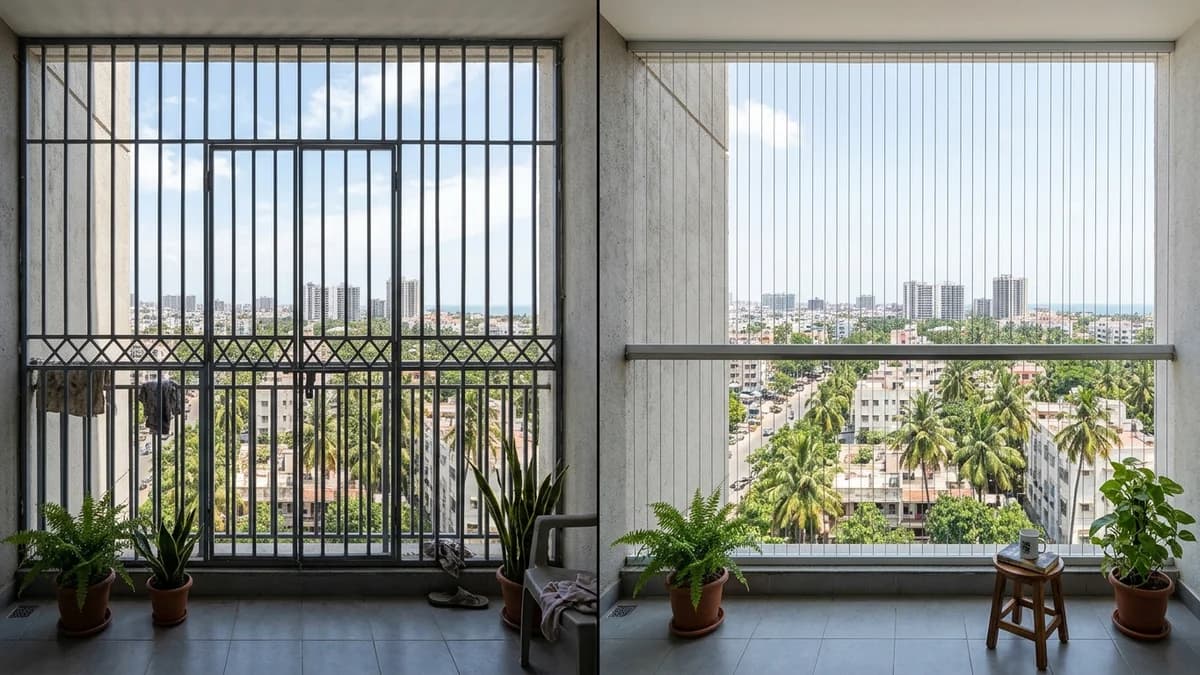
When evaluating invisible grills for a home or apartment balcony in Chennai, two installations may look virtually identical from across the room, yet differ significantly in durability, structural safety, and long-term performance. The visible wires, mounting frames, and anchoring hardware can be fabricated from very different material grades and specifications. Before approving any installation, homeowners should verify six core material factors: the stainless-steel grade (SS 304 vs. SS 316), the actual core cable diameter and strand construction, the protective nylon coating, the proposed cable spacing, the quality of the aluminium tracks and masonry anchors, and the written warranty documentation.
Key Takeaway for Homeowners
An invisible grill is an engineered safety barrier, not merely an architectural accessory. The strength of the installation relies entirely on the mechanical synergy between the stainless-steel wire rope, the structural mounting tracks, and the concrete fasteners. If a contractor presents a brief estimate that simply says "standard stainless steel grill," ask for detailed specifications before committing to an advance payment.
Below is a structured breakdown of the six crucial material questions every property owner in Chennai should ask before selecting an invisible grill system.
Question 1: What Stainless-Steel Grade Is Used — SS 304 or SS 316?
Stainless steel is an alloy composed primarily of iron, carbon, chromium, and nickel. The term "stainless" does not mean the metal is completely immune to staining or environmental reaction under every circumstance; rather, it indicates that the chromium content (typically at least 10.5% to 18%) forms a microscopic, self-repairing chromium-oxide passive film on the surface that resists oxidation.
In the residential invisible grill sector, two primary austenitic stainless-steel grades are commonly referenced: AISI 304 and AISI 316. Understanding how these two alloys differ is essential when planning an installation in Chennai:
- Grade 304 Stainless Steel: Commonly referred to as 18/8 stainless steel, it contains approximately 18% chromium and 8% nickel. It provides good tensile strength and reliable corrosion resistance in standard urban, indoor, or sheltered environments. In inland regions with moderate humidity, SS 304 can serve effectively as a protective barrier when maintained regularly.
- Grade 316 Stainless Steel: Contains roughly 16% to 18% chromium and 10% to 14% nickel, along with a critical alloying addition: 2.0% to 3.0% molybdenum. The inclusion of molybdenum substantially increases the alloy's resistance to localised chloride pitting and crevice corrosion, making it the industry standard for marine environments, industrial plants, and coastal architecture.
Why Grade Selection Matters for Chennai's Coastal Climate
Chennai presents a demanding tropical coastal climate. Relative humidity frequently hovers between 70% and 85%, and prevailing onshore breezes carry microscopic saline moisture (airborne sodium chloride droplets) well inland from the Bay of Bengal.
In coastal neighbourhoods such as the East Coast Road (ECR), Besant Nagar, Thiruvanmiyur, Santhome, and portions of Adyar, chloride deposition on exposed metal surfaces is high. In these areas, SS 304 is more susceptible to "tea-staining"—a brown cosmetic surface oxidation that, if left unattended, can develop into localised pitting. SS 316 provides superior protection against chloride attack, making it the more durable and conservative choice for open balconies.
However, it is important to maintain balanced expectations. SS 304 is not automatically unsuitable for every home in Chennai; in sheltered inland apartments far from the beach with good cross-ventilation, it can perform well if wiped periodically. Conversely, SS 316 is not completely impervious to neglect—if fine construction dust, acid cleaners, or airborne pollutants accumulate undisturbed, even high-grade steel can show superficial discoloration. The steel grade should always be specified clearly in your written quotation so you know exactly what you are paying for.
| Material Criterion | Grade 304 Stainless Steel | Grade 316 Stainless Steel |
|---|---|---|
| Key Alloying Elements | ~18% Chromium, ~8% Nickel, No Molybdenum | ~16-18% Chromium, ~10-14% Nickel, 2-3% Molybdenum |
| Chloride Pitting Resistance | Moderate; vulnerable to salt air pitting | High; excellent resistance to saline environments |
| Recommended Chennai Exposure | Sheltered inland openings, well-ventilated interiors | Open exterior balconies, coastal belts, high-rise windward facades |
| Maintenance Requirement | Regular wipe-downs to prevent surface tea-staining | Periodic cleaning to remove atmospheric grime |
| Questions to Ask Your Installer | "Is the cable core explicitly certified as Grade 316 or 304? Can you provide a Mill Test Certificate or perform a molybdenum spot test?" | |
Question 2: What Is the Actual Cable Diameter and Construction?
Invisible grill cables are not solid metal rods. Instead, they are engineered multi-strand wire ropes made by twisting dozens of fine stainless-steel wire filaments around a central core. This stranded construction provides high tensile flexibility, allowing the cable to absorb impact energy without permanent bending.
When reviewing quotations, one of the most critical distinctions to understand is the difference between the core steel diameter and the finished coated diameter:
Core Steel Diameter
This is the actual metallic wire rope that bears the physical load. Common core diameters range from 1.5 mm to 2.2 mm. It is the metal core alone that determines the cable's structural tensile strength.
Finished Coated Diameter
This represents the total thickness including the outer transparent polymer sheath (often 2.0 mm, 2.5 mm, or 3.0 mm total). A cable advertised as "3.0 mm" might have a sturdy 2.2 mm steel core with a 0.4 mm sheath, or a weaker 1.5 mm core with a thick 0.75 mm plastic layer.
A thicker-looking plastic coating does not compensate for a thin, under-specified steel core. If an estimate simply lists "2.5 mm invisible grill wire," ask the contractor to document the exact breakdown. For example, a standard residential specification might read:
Recommended Written Quotation Specification:
• Stainless Steel Grade: AISI 316 Marine Grade
• Cable Construction: 7 × 7 Multi-strand wire rope
• Core Steel Diameter: 2.0 mm (nominal)
• Finished Diameter: 2.5 mm (inclusive of virgin nylon outer sheath)
• Manufacturer Technical Data Sheet: Attached upon request
The intended balcony opening, floor elevation, and building architecture influence cable selection. While thicker steel cores offer higher mechanical load resistance, overall safety depends on how securely the complete system—including tracks and anchors—is installed. Homeowners should avoid assuming any single diameter guarantees absolute safety on its own.
Question 3: Is the Cable Nylon-Coated, and What Does the Coating Do?
Most residential invisible grill systems utilise an extruded protective polymer layer over the stainless-steel wire rope. Understanding the function and limits of this coating helps homeowners evaluate product quality:
- Surface Protection: The sheath seals the crevices between twisted steel strands, reducing the accumulation of airborne dust, pollution particles, and salt moisture.
- Tactile Comfort: Stranded bare wire ropes can have fine micro-roughness. A smooth polymer coating makes the cables comfortable to touch and eliminates the risk of accidental scratches on hands, children's fingers, or pet paws.
- Aesthetic Clarity: High-grade transparent coatings provide a sleek, uniform appearance that reflects sunlight subtly without looking cloudy.
However, the longevity of the coating depends heavily on its polymer formulation. High-quality installations generally employ virgin nylon (such as Nylon-12 or UV-stabilised engineering polymers) or fluoropolymers. These materials resist embrittlement and discoloration when exposed to tropical solar radiation.
Conversely, substandard coatings formulated from cheap recycled PVC or non-UV-stabilised plastics can deteriorate under Chennai's intense sun. Over a period of 12 to 24 months, low-quality plastics can turn yellow, become brittle, crack, or peel away from the metal. Once the coating cracks, moisture can become trapped against the steel strands, accelerating crevice corrosion.
Homeowners should clarify whether the quoted cable has an outer coating, confirm the polymer type, and understand that coated cables still require periodic inspection. If you notice discoloration, hardening, or peeling during routine balcony cleaning, have the installer inspect the affected section.
Question 4: What Cable Spacing Is Proposed, and Is It Appropriate?
Cable spacing refers to the clear horizontal distance between adjacent vertical cables (or vertical distance between horizontal cables). Spacing directly dictates the barrier's openness, visual transparency, and practical containment capability.
In residential installations, common spacing options include:
2-Inch Spacing (~50 mm)
Provides a dense protective envelope. Recommended for families with active infants, toddlers, or small domestic pets (such as cats and small dogs) where preventing accidental slips or head entrapment is paramount. It also acts as an effective deterrent against urban pigeons.
3-Inch Spacing (~75 mm)
The widely chosen standard for general adult fall prevention, window openings, and older children. It offers enhanced optical invisibility while providing a reliable barrier.
4-Inch Spacing (~100 mm)
Occasionally suggested for purely decorative partitions or low-risk commercial applications. It is generally not advised for high-rise apartment balconies where child safety is a concern.
The Economic Factor: Cable spacing has a major impact on quotation pricing. A 10-foot wide balcony with 2-inch spacing requires approximately 60 vertical cable lines, whereas 3-inch spacing requires approximately 40 lines. Choosing wider spacing reduces the required material and labor by roughly one-third.
Homeowners should never compromise on spacing simply to reduce the initial invoice cost. If you have young children or pets, a closer spacing chosen in accordance with relevant safety considerations provides peace of mind. Ensure the exact proposed spacing is explicitly stated in the written estimate before signing off.
Question 5: Are the Tracks, Anchors, and Fittings Made from Suitable Materials?
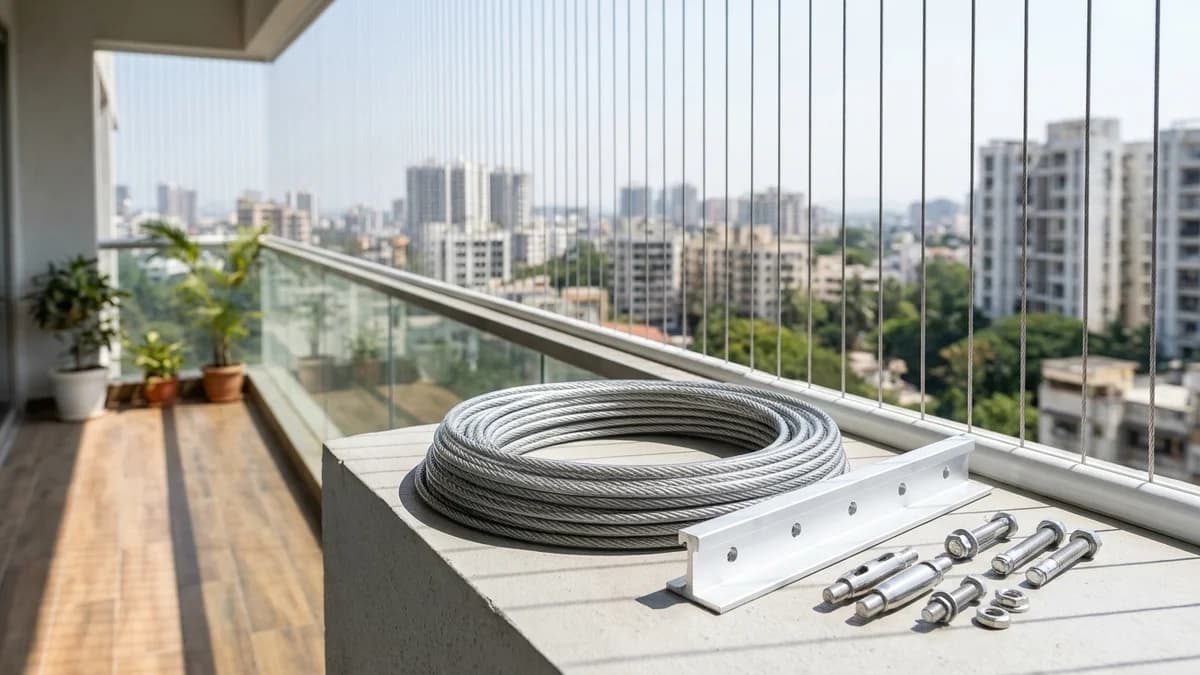
While homeowners naturally focus on the visible steel cables, an invisible grill is an integrated structural assembly. The cables cannot remain taut or safe without durable supporting tracks, robust anchoring fasteners, and precision tensioning components.
Key supporting components to inspect include:
- Mounting Tracks: These horizontal or vertical tracks house the cable fixing points and tensioners. They should be fabricated from architectural-grade extruded aluminium alloy (such as 6063-T6) with sufficient structural wall thickness (typically 1.8 mm to 2.2 mm). Tracks should feature an electrostatic powder-coated or anodised finish to resist corrosion from coastal moisture. Flimsy, thin-walled aluminium profiles can bow inward under continuous cable tension.
- Masonry Anchor Bolts: High-tensile cables pull continuously against the concrete structure. Installers should use heavy-duty stainless-steel mechanical expansion anchor bolts or certified masonry fasteners. Generic plastic wall plugs or ordinary mild-steel screws should never be used as primary anchors in structural concrete, as they can loosen under cyclical wind vibration.
- End Fittings and Tensioners: Cable locks, barrel screws, and turnbuckles should be manufactured from corrosion-resistant alloys compatible with the stainless-steel cables to prevent galvanic corrosion.
Assessing the Installation Substrate
No anchor is universal. An experienced installer will examine the building surface before drilling. Solid reinforced concrete (such as balcony ceiling slabs and structural lintels) provides an ideal substrate for expansion anchor bolts. However, if your balcony perimeter consists of hollow clay blocks, lightweight aerated concrete (AAC blocks), or decorative plaster, standard mechanical anchors may not achieve adequate holding grip.
In non-solid substrates, specialised fixing methods—such as chemical anchor bonding or through-bolting—may be required. A reputable installer will inspect your balcony structure during the site measurement and recommend the appropriate anchoring approach for your specific building.
Question 6: What Warranty and Material Documentation Will You Receive?
In the residential home-improvement sector, verbal assurances are common. An installer might informally promise that "this cable will last fifteen years without rust." However, if quality issues emerge two years later, verbal claims offer no legal or commercial protection.
Homeowners should request formal, written documentation before proceeding with an order. Essential documentation includes:
1. Itemised Quotation
Specifying the steel grade (e.g. SS 316), core diameter, finished diameter, cable spacing, track profile, and fastener type, along with total square footage.
2. Manufacturer Material Specification Sheet
Confirming the alloy standard, tensile test data, and polymer coating details.
3. Clear Warranty Certificate
Stating the warranty duration, exact coverage (e.g. against material manufacturing defects or premature corrosion), exclusions (such as accidental physical damage or exposure to harsh cleaning chemicals), and the formal claim process.
4. Service and Re-Tensioning Policy
Clarifying whether routine inspection visits, re-tensioning, or minor hardware adjustments are included during the initial post-installation period.
Having these details in writing allows you to compare quotations objectively. When comparing two service providers in Chennai, a slightly higher quote that includes genuine SS 316 certification, heavy-duty aluminium tracks, and a documented warranty represents far better long-term value than a cheap quote lacking technical accountability.
Invisible Grill Material Checklist Before Paying an Advance
Use this printable checklist to review your written quotation before approving an installation or paying a financial deposit:
| Item to Verify | Recommended Specification | Status / Confirmed in Writing? |
|---|---|---|
| Stainless Steel Grade | AISI SS 316 (Marine Grade) or SS 304 (Sheltered Inland) | [ ] Yes [ ] No |
| Core Steel Diameter | Explicitly stated (typically 1.8 mm to 2.2 mm nominal) | [ ] Yes [ ] No |
| Finished Diameter | Stated with coating thickness (e.g. 2.5 mm or 3.0 mm total) | [ ] Yes [ ] No |
| Coating Material | Virgin UV-stabilised nylon or fluoropolymer | [ ] Yes [ ] No |
| Cable Spacing | Clearly specified (e.g. 2-inch for child/pet safety, 3-inch standard) | [ ] Yes [ ] No |
| Track Profile & Finish | Architectural aluminium (6063-T6), powder-coated or anodised | [ ] Yes [ ] No |
| Fastener Type | Stainless steel or heavy-duty mechanical expansion bolts | [ ] Yes [ ] No |
| Substrate Suitability | Verified solid concrete or appropriate anchoring specified | [ ] Yes [ ] No |
| Itemised Pricing | Transparent breakdown of area, hardware, and installation scope | [ ] Yes [ ] No |
| Written Warranty | Documented duration, coverage terms, and contact details | [ ] Yes [ ] No |
How Chennai's Climate Affects Material Selection
When evaluating metal building components, it is helpful to distinguish between general atmospheric humidity and airborne chloride exposure:
- Humidity Alone: High humidity promotes moisture condensation on surfaces, which accelerates standard oxidation on carbon steels and poorly coated metals. However, high-grade stainless steels with adequate chromium and nickel handle clean moisture relatively well.
- Chloride (Salt) Exposure: Salt aerosols carried by ocean winds contain chloride ions (Cl⁻). Chloride ions are chemically aggressive: they penetrate microscopic imperfections in the passive chromium-oxide layer, triggering pitting corrosion. Once a pit initiates, the localized micro-environment becomes acidic, accelerating internal corrosion beneath the surface.
Not all residential areas in Chennai experience identical environmental exposure. High-rise apartments along the coastal corridor—including the East Coast Road (ECR), Besant Nagar, Marina, Santhome, and Kottivakkam—face constant maritime airflow and require the most corrosion-resistant specifications, such as genuine SS 316 cables and anodised aluminium tracks.
Inland residential neighbourhoods—such as Anna Nagar, Porur, Mogappair, Ambattur, and Chromepet—experience lower chloride concentrations, although high ambient humidity and seasonal monsoons remain significant. In these locations, local factors such as building height, orientation relative to prevailing winds, and balcony sheltering play an important role. Discussing your building's specific exposure with a knowledgeable installer ensures you select materials suited to your location.
What Are the Warning Signs of a Poor-Quality Quotation?
A brief or informal quotation does not necessarily mean an installer does poor work, but ambiguity creates avoidable risks for homeowners. If an estimate arrives with any of the following omissions, request clarification in writing before proceeding:
Warning Sign 1: Vague "Stainless Steel" Label Without a Grade
If a quotation simply says "SS Wire Grill" without identifying whether it is Grade 304, Grade 316, or an inferior grade, there is no guarantee of corrosion performance. Always ask for the exact alloy grade.
Warning Sign 2: Quoting Only Finished Diameter Without Core Specification
Listing "3.0 mm wire" without clarifying the steel core diameter allows an installer to substitute a thin 1.5 mm core wire wrapped in thick plastic. Ensure both core and coated dimensions are stated.
Warning Sign 3: Omission of Cable Spacing Dimensions
If the gap spacing is not written down, an installer might install 3-inch or 4-inch spacing on-site when you intended to have closer 2-inch child safety spacing.
Warning Sign 4: No Information on Tracks or Concrete Anchoring
Omitting the track alloy, thickness, and anchor bolt type leaves the supporting framework undefined. Weak anchors can compromise the safety of the entire installation.
Warning Sign 5: Verbal Warranties Without Written Terms
A promise of a "10-year guarantee" written nowhere on the bill or company letterhead is difficult to claim later. Insist on a written warranty document detailing coverage and exclusions.
Requesting clear, written answers to these points is standard practice and helps establish a transparent relationship between property owners and professional contractors.
Frequently Asked Questions
Which is better for invisible grills in Chennai, SS 304 or SS 316?
SS 316 is generally preferable for outdoor balconies in Chennai, particularly within coastal and high-humidity corridors. It contains 2% to 3% molybdenum, which provides superior resistance to pitting corrosion caused by airborne chlorides. SS 304 can perform acceptably in sheltered, inland settings, but requires diligent cleaning and inspection to prevent surface tea-staining.
How can I verify the stainless-steel grade?
You can verify the steel grade by requesting a manufacturer's Mill Test Certificate (MTC) for the batch and asking the installer to perform an on-site chemical reagent spot test. Reagent drops react differently with molybdenum, turning pink or amber on genuine SS 316 while turning dark grey or black on SS 304 or lower grades.
What cable diameter should I choose for a balcony?
Most residential balcony installations use cables with an overall finished diameter between 2.5 mm and 3.0 mm. Always ask your installer to state the core steel diameter separately from the outer coating thickness, as a 2.0 mm steel core with a 0.5 mm nylon sheath provides significantly higher load-bearing capacity than a thinner core with thicker plastic.
Why are invisible grill cables coated with nylon?
A clear nylon outer coating protects the multi-strand stainless-steel core from atmospheric moisture, salt deposition, and grime accumulation. It also creates a smooth, snag-free surface that is comfortable to touch, prevents micro-scratches on hands or pet paws, and improves the overall visual neatness of the installation.
Does cable spacing affect the total installation cost?
Yes. Closer spacing, such as 2 inches (50 mm), requires roughly 50% more linear feet of cable, additional anchoring turnbuckles, and more technician labor than 3-inch (75 mm) spacing. While wider spacing lowers the initial quotation cost, cable spacing should always be selected based on safety needs—such as child and pet protection—rather than price alone.
Why are aluminium tracks and anchors important?
Tensioned cables exert significant cumulative lateral pull on the building slab. High-strength extruded aluminium tracks (such as 6063-T6 alloy) distribute this tension evenly, while heavy-duty mechanical expansion anchor bolts secure the system directly into solid concrete. Substandard tracks or generic plastic wall plugs can flex, loosen over time, or pull free under load.
How often should invisible grill materials be inspected?
Homeowners should visually inspect their invisible grills every six to twelve months. Check for uniform cable tension by gently pulling adjacent wires, inspect the outer nylon coating for hairline cracks or peeling, and examine the aluminium track and anchor fixings for any signs of loosening, moisture seepage, or surface discoloration.
What details should an invisible grill quotation include?
A comprehensive written quotation should explicitly itemise the stainless-steel grade (e.g. SS 316), the core steel diameter and finished coated diameter, the cable construction, the protective coating specification, proposed cable spacing, track profile and alloy grade, anchor bolt type, total measured area, installation scope, and written warranty terms.
Planning an Invisible Grill Installation in Chennai?
When evaluating invisible grills, transparent material specifications make all the difference. Explore our dedicated pages on invisible grill installation in Chennai, explore comprehensive balcony safety solutions, and review specialized options for child safety nets for balconies and pigeon safety nets.
Planning an invisible grill installation for your Chennai home? Contact Poorna Pigeon Nets & Invisible Grills to discuss your balcony dimensions, material requirements, and installation options. Request a quotation that clearly identifies the proposed cable grade, coating, tracks, fittings, installation scope, and warranty conditions.
Discuss Your Balcony Safety Requirements with Poorna Pigeon Nets & Invisible Grills
Based in Kodambakkam, Poorna Pigeon Nets & Invisible Grills provides professional balcony and window safety solutions across Chennai with clear material specifications, verified hardware, and dependable after-sales support.

Poorna Pigeon Nets & Invisible Grills Technical Installation Team
Balcony Safety & Invisible Grills Specialists
Specializing in bird control, balcony safety netting, and invisible grill installations across Chennai since 2015.
Related Safety Articles
Common Balcony Safety Problems in Anna Nagar Apartments and How to Solve Them
Read Article →
Balcony Safety Nets in Kodambakkam, Chennai – Benefits, Installation & Buying Guide
Read Article →